
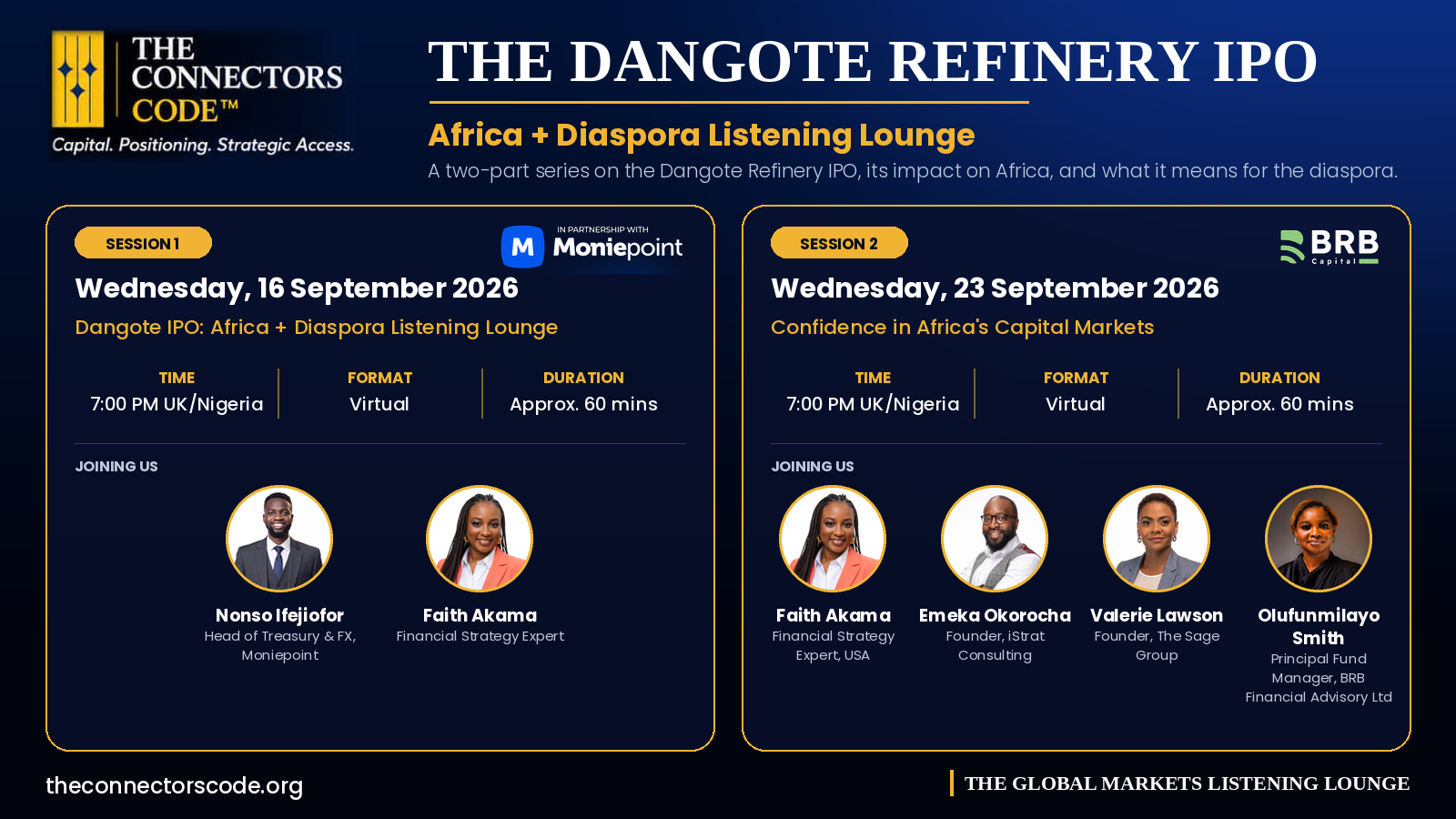
From the Dangote Refinery IPO to infrastructure, wealth creation and the future of investing in Africa, two Global Markets Listening Lounges brought together more than 100 people for conversations about where capital is moving and who gets to participate.
What happens when you put investors, business leaders, finance professionals and members of the African diaspora in the same room and give them permission to ask the questions they actually have about investing in Africa?
You get conversations that go far beyond the headline.
Over two Global Markets Listening Lounges, The Connectors Code partnered with MoneyPoint and BRB Capital to create spaces for exactly that kind of conversation.
The first session, hosted in partnership with MoneyPoint, brought together approximately 60 participants for a two-hour discussion centred on the Dangote Refinery IPO.
The second, in partnership with BRB Capital, brought together about 50 participants for an extended conversation of almost three hours, widening the lens from one IPO to the broader questions shaping investment across Africa and the diaspora.
Different partners. Different conversations. One shared focus: how do we create greater understanding, access and participation in Africa's capital markets?
Starting with the Dangote IPO
The first Listening Lounge took place against the backdrop of significant interest in the Dangote Refinery IPO.
With the offer price discussed at ₦525 per share, the conversation naturally began with valuation. But it quickly became clear that participants were interested in more than the price.
They wanted to understand the business behind the shares.
Faith Manuel moderated the session, with contributions from Nonso of MoneyPoint, Valerie Lawson, Choma, Nkem Igwe, Amuga, Larry, Tosin and Jose, as well as other participants joining the conversation.
Valerie Lawson brought an energy-sector perspective to the discussion, looking at the refinery's fundamentals, its scale, expansion plans and the importance of crude supply.
Nonso brought the conversation back to the investor's perspective, discussing access, participation and some of the practical considerations around the IPO.
Together, the discussion explored what the refinery could mean as a major industrial asset and what investors should consider before making decisions around it.
More Than a Question of Price
One of the most interesting parts of the conversation was the discussion around the percentage of the company being offered to the public.
Participants questioned what a relatively small public float could mean for the market and whether the IPO should be viewed purely as a conventional capital-raising exercise.
Nkem raised a broader question: could bringing ordinary Nigerians into ownership of a major national asset create a wider constituency around the refinery?
That opened up a conversation about what public participation can mean beyond the financial transaction itself.
For Amuga, the discussion was also about time.
Investing, he argued, should not always be viewed through the lens of immediate returns. Understanding the asset and being willing to think about the long term can be just as important as the initial purchase decision.
That distinction between investing and simply watching a share price became one of the recurring ideas of the evening.
The Diaspora Was Part of the Conversation
The Lounge also created space for Africans outside the continent to ask practical questions about participation.
Tosin and Jose joined from Scotland, bringing the perspective of members of the diaspora looking at African investment opportunities from abroad.
How do you participate?
What documentation do you need?
How do you access the market?
What happens when you are investing across currencies and jurisdictions?
These questions were particularly relevant to MoneyPoint's role in the partnership.
The session demonstrated how fintech and financial platforms can help bridge the gap between interest in African opportunities and the practical mechanisms required to participate.
It also reinforced a point that came up repeatedly: access without education is not enough.
People need to understand what they are entering into, the risks involved and the underlying asset.
Then the Conversation Got Bigger
If the first Lounge centred on one major transaction, the second asked a much broader question:
What does it actually mean to invest in Africa?
The BRB Capital Listening Lounge ran for almost three hours, with approximately 50 people participating.
The longer format allowed the conversation to move across several interconnected topics: investing versus trading, portfolio construction, infrastructure, international investment, financial education, risk, the African diaspora and the future of capital on the continent.
The conversation included perspectives from Valerie Lawson, Valerie Charman, Dr. Bella, Emeka and other contributors, alongside Faith and members of the TCC community.
And as the conversation unfolded, one thing became clear.
There is no single African investor.
Different Investors, Different Objectives
One of the strongest threads of the BRB Capital conversation was the importance of understanding your own investment objectives.
Some participants spoke from the perspective of long-term investors.
Others were interested in trading.
Some were looking at African opportunities.
Others were considering international markets.
The discussion around trading was particularly candid.
Participants highlighted the difference between seeing someone make money in the markets and actually understanding the process that produced those returns.
Trading requires knowledge of the market, an understanding of risk and, importantly, an awareness that short-term market movements can work in either direction.
The conversation also touched on more diversified approaches, including ETFs and professionally managed portfolios, particularly for people who may not want to actively trade individual securities.
The larger point was simple:
There is a difference between investing because you understand an opportunity and investing because you have seen someone else make money from it.
What Makes Investors Confident in Africa?
The second Lounge also tackled a question that sits at the heart of Africa's capital markets:
Why do some investors remain cautious about investing on the continent?
The conversation did not reduce the answer to a single explanation.
Participants discussed currency risk, liquidity, regulation, market infrastructure, the ease of moving capital, information and familiarity with African markets.
But they also pushed back against the idea that international investors simply do not see Africa's potential.
The issue, as discussed during the session, is often more practical.
Can an investor enter the market?
Can they understand the opportunity?
Can they manage the risks?
Can they access their returns?
Can they exit when they need to?
These are questions that matter to investors anywhere in the world. The difference is that African markets often require investors to navigate additional layers of complexity.
Bringing Infrastructure Within Reach
Infrastructure was another major theme.
Large infrastructure opportunities can require significant amounts of capital, putting them beyond the reach of many individual investors.
Valerie Lawson discussed how investment structures can potentially break down larger opportunities into smaller participation sizes.
That creates an interesting possibility: instead of infrastructure being something individuals simply read about or benefit from indirectly, could more people become participants in the assets themselves?
This is particularly relevant across Africa, where the infrastructure gap remains significant and the need for capital spans energy, transport, technology and other sectors.
Looking Beyond Today's Opportunities
The conversation also moved beyond oil.
While the Dangote Refinery was central to the first Lounge, the second explored what could come after today's dominant industries.
Participants discussed energy transition, power, artificial intelligence, critical minerals, technology and the infrastructure needed to support future economic growth.
The point was not to dismiss existing industries.
It was to encourage people to look further ahead.
If today's investments are shaped by today's economy, what industries will shape tomorrow's?
That question is increasingly important for anyone thinking about African markets over a longer horizon.
Why These Conversations Matter
It would have been easy for both Listening Lounges to become promotional conversations.
They did not.
The value of the sessions came from the questions.
Questions about valuation.
Questions about access.
Questions about risk.
Questions about whether to invest at home or abroad.
Questions about infrastructure.
Questions about long-term wealth.
Questions about what Africa's capital markets could look like as more people begin to participate.
That is where the partnership with MoneyPoint and BRB Capital became particularly valuable.
MoneyPoint helped ground the Dangote IPO conversation in the practical realities of access and participation.
BRB Capital expanded the conversation into investment strategy, wealth management, infrastructure and the broader investment ecosystem.
Together, the partnerships helped create two different but complementary conversations.
Connecting Capital, Knowledge and People
At The Connectors Code, we believe conversations can be infrastructure too.
Sometimes the first step toward an investment is not opening an account.
It is asking a question.
Sometimes it is meeting someone who has already navigated the process.
Sometimes it is hearing an opposing perspective that makes you rethink an assumption.
And sometimes it is simply learning enough to know what questions to ask next.
Across the two Global Markets Listening Lounges, approximately 110 people joined us and spent nearly five hours collectively exploring those questions.
From the Dangote Refinery IPO to the future of African infrastructure, the conversations showed that there is a growing appetite for deeper, more informed discussions about capital and opportunity on the continent.
The work now is to keep creating the spaces where those conversations can happen.
Because Africa's investment story is not only about the capital coming in.
It is also about the people who are ready to understand it, participate in it and help shape what comes next.