
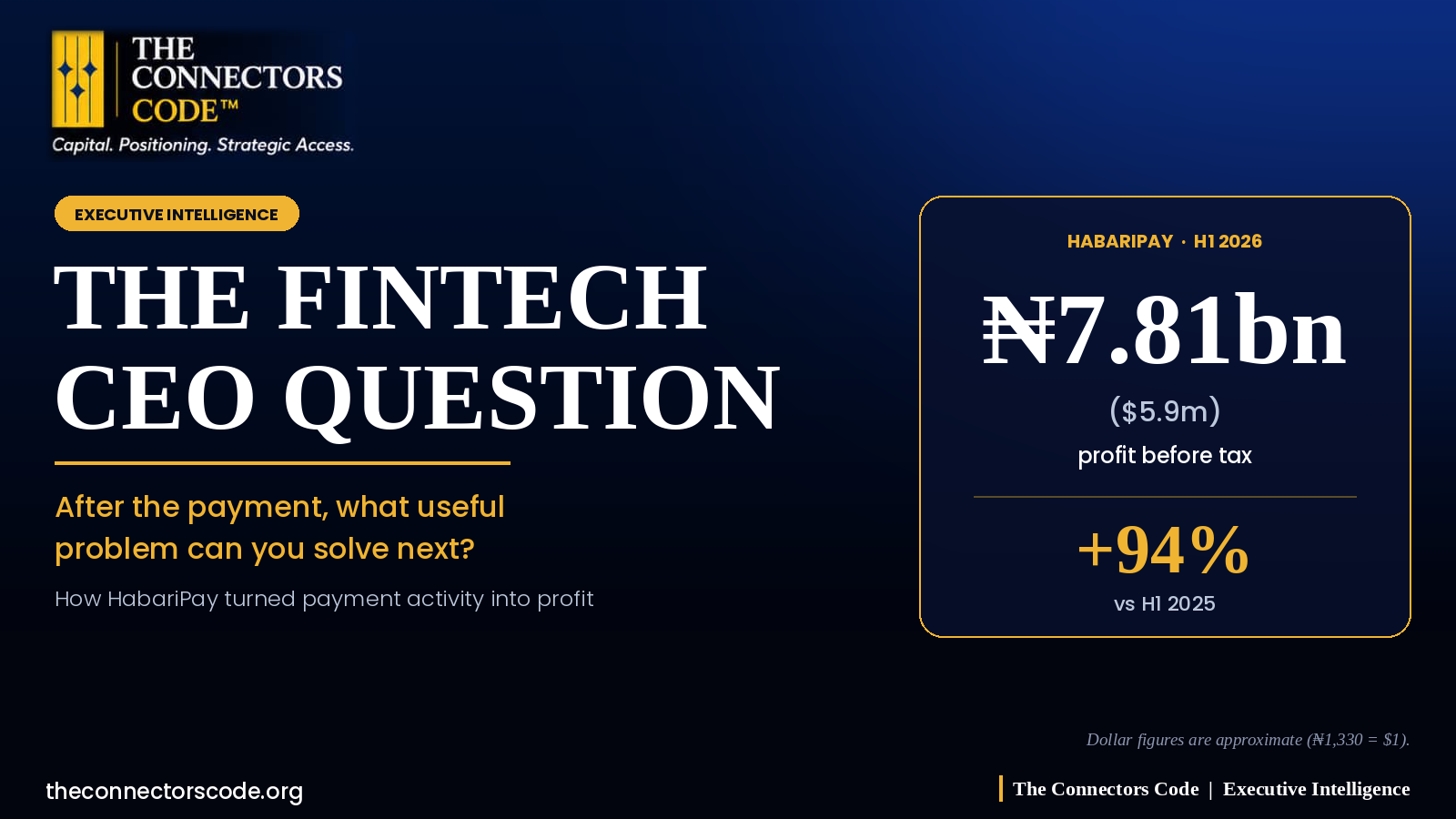
HabariPay’s ₦7.81bn ($5.9m) six-month profit is a case study in turning payment activity into a business that earns.
A fintech can process billions in payments and still struggle to make money. So when HabariPay reported ₦7.81bn ($5.9m) in profit before tax for the first half of 2026, the interesting question was: what turned payment activity into profit?
The answer matters well beyond HabariPay. Across the industry, fintech leaders are being asked to show what happens after they attract users and move money. Do customers stay? Do they use more of the service? Does income grow faster than the cost of delivering it?
Why this question matters now
Fintech investment is recovering, but the market has changed.
Global fintech investment reached $116bn in 2025, up from $95.5bn in 2024. That is encouraging. It is still well below the $210bn raised in 2021. More tellingly, the number of deals fell to 4,719 in 2025, an eight-year low. More money went into fewer deals.
The picture is particularly relevant in Africa. Fintech remained the largest sector for startup equity investment in 2025, but the amount raised fell 43% to $769m. Capital has not disappeared. Investors are making more deliberate choices about where it goes.
That puts pressure on fintech CEOs to tell a fuller story. Payment volume shows demand. Customer numbers show reach. Investors also want to see how the company earns, what it costs to serve each customer, and whether growth can continue without an equally large rise in spending.
The HabariPay result
HabariPay is GTCO’s payments business. In the first half of 2025, it made ₦4.02bn ($3.0m) in profit before tax. In the first half of 2026, that rose to ₦7.81bn ($5.9m)—an increase of about 94%.
Its operating income grew 87% to ₦9.44bn ($7.1m). Operating expenses grew 59% to ₦1.63bn ($1.2m).
Those percentages tell the central story: HabariPay earned more from its activity, while its reported costs grew at a slower rate. That is what turned strong income growth into even stronger profit growth.
It is tempting to credit one product or one major partnership. GTCO’s published accounts do not provide enough detail to do that. They show HabariPay’s total result, but do not say how much profit came from each part of the business.
How HabariPay earns
HabariPay works at several points in a payment journey.
Its payment gateway helps businesses accept payments through channels such as cards, bank transfers, USSD and virtual accounts. Its switching business processes transfers and card transactions. It also provides services such as bill payments, airtime and bulk SMS.
HabariPay earns net commissions on merchant transactions and margins on some of those additional services. Each individual payment may produce a relatively small amount of income. The model becomes more powerful when many customers and businesses use the service regularly—and the cost of handling that activity stays under control.
There is another part of the story: distribution. As a GTCO company, HabariPay can build on an established banking network and business relationships. GTCO says it has expanded HabariPay’s merchant network, supported GTBank’s POS growth and built switching partnerships with banks and fintechs.
That does not mean every independent fintech needs a bank behind it. It means every CEO needs a clear answer to a practical question: how will the right customers find us, start using us and keep using us without acquisition costs consuming the value they bring?
What the global market teaches
HabariPay’s model is its own, but three global companies show different ways to build value around payments.
Stripe: help the customer earn and manage revenue. Businesses on Stripe generated $1.9tn in payment volume in 2025. That is the value of payments handled through the platform, not Stripe’s income or profit. Stripe has built further tools for billing, invoicing and tax. It says that group of products is on track to reach a $1bn annual revenue run rate in 2026.
A business using Stripe may begin by needing a way to accept a payment. As it grows, it may also need to charge customers every month, send invoices or manage taxes across markets. Stripe has chosen to stay close to those problems. The lesson is to understand the work your customer must do around a payment, then decide which part you can make easier.
Adyen: make complexity easier for large businesses. Adyen processed €803.8bn in payments in the first half of 2026 and reported €1.30bn in net revenue. It brings online and in-store payments, data and other financial tools into one system for businesses operating across markets.
For a large merchant, taking a payment is rarely the only challenge. It also needs to know whether payments succeed, what happens when they fail, and how money moves across its operations. Adyen’s approach is to make those connected tasks work together. The lesson for fintech CEOs is that customers may pay for a better outcome, not simply another way to move money.
Square: become useful in the customer’s daily work. Square began with a way for smaller businesses to accept card payments. It now offers tools for point of sale, online commerce, staff management and cash flow. It also connects sellers with other services: Square says 71% of its enterprise sellers use at least one partner tool on its platform.
A restaurant, for example, may need payments, stock information and staff tools to work together. When those tools make daily work easier, the relationship can become deeper than a transaction fee. Square shows how a payments company can grow by paying attention to the business behind the payment.
These examples use different financial measures and serve different customers. Their figures should not be read as a league table against HabariPay. They help us see the strategic choices available: serve more of a customer’s needs, solve a difficult part of the payment process, or connect payments to the work of running a business.
Five questions for fintech CEOs
1. What do we keep from each payment?
Look beyond the total value processed. After processing fees, customer support, fraud losses and other direct costs, how much does each type of transaction contribute? The answer may differ sharply between customers and payment channels.
2. Are our existing customers growing with us?
New sign-ups matter, but so does the behaviour of businesses that joined six or twelve months ago. Are they still active? Are they processing more payments? Are they using more services? A strong customer relationship should become visible in the numbers.
3. What problem comes immediately after the payment?
For one merchant, it may be knowing which invoices have been paid. For another, it may be faster settlement, easier reconciliation or a clearer picture of daily sales. Start with a problem customers already have. Then test whether they value the solution enough to use and pay for it.
4. How efficiently can we reach more customers?
HabariPay has access to GTCO’s wider ecosystem. Other fintechs may grow through software platforms, industry partners or a strong position in a particular market. The key is to know what it costs to win a customer and how long it takes to earn that cost back.
5. Can we stay reliable as we scale?
A merchant may forgive a missing feature. A failed payment during a busy sales period is harder to forget. Successful transactions, prompt settlement and good support are part of the value a payments company sells. Growth has to preserve them.
The takeaway
HabariPay’s ₦7.81bn ($5.9m) result is evidence of a business earning more as it grows. The published figures show income rising faster than reported costs. They do not yet show which products contributed most, so that remains an important question to watch.
The wider lesson is a question every fintech CEO should be able to answer clearly:
After helping a customer make or receive a payment, what useful problem can you solve next—and can you solve it profitably at scale?
That is a stronger story for customers, boards and investors than payment volume alone.
The Connectors Code | Executive Intelligence
Dollar equivalents are approximate, using ₦1,330 to $1 for illustration. They are not figures reported in US dollars by GTCO.
Editorial source check: The HabariPay figures and business lines come from GTCO’s audited H1 2026 statements and annual report. The funding figures come from KPMG and Partech; the global company figures come from Stripe, Adyen and Square disclosures.